A Musical Education
Early Days
I grew up in a musical family.
As I mentioned in my previous chapter, my dad was a teacher, who played the drums,
sang in choirs and acted in plays and musicals, and
my mum was a teacher who sang and played piano for her infants school students.
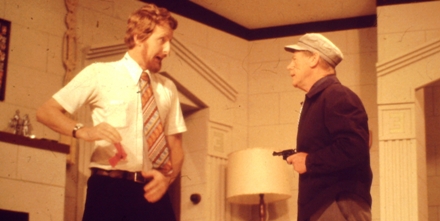
My oldest sister played the piano, and went on later in life to complete her Amus.A
in piano and voice, and write an Italian opera for her Masters degree.
She also performed lead roles in amateur musicals.
My second oldest sister played the piano and guitar and other instruments,
and it was her guitar I first picked up to play.
Like my sisters before me, I was sent off to piano lessons. I moved quickly through the levels, skipping preliminary and 2nd grade, and getting honours in my 1st and 3rd grade piano exams. However, I hit a brick wall when I was preparing for my 4th grade piano exams. I could play the slower emotional pieces like Moonlight Sonata or Fur Elise well enough, but struggled to master the complex technical pieces which left me cold.
I continued with piano on a less formal basis for a while with a different teacher, learning to play more popular pieces and more modern styles, but had lost the passion to practice piano.
I was listening to a lot of pop music on the radio. I had a criteria to measure which songs I really liked. They would give me a certain shiver up my spine. Very few songs met this standard, with the early hits of the Easybeats being the most common exception.
I felt like I was being dishonest and dropping my standards when I started to buy records which didn't make me feel that way. As an adult, while I no longer get that same physical reaction, I now get a strong emotional reaction to music which moves me.
After my sister showed me a few basic chords on her guitar I found it easy to pick up the rest. I played a mix of chords, riffs and bass along with the songs on the radio. Soon Mum and Dad bought me own guitar. I was drawn to the sound and the role of the bass guitar, and how a good bass player and a good bass line could "make" a hit song.
"I want to be a bass player in a rock band"
By late primary school it was clear to me what I wanted to be and what I wanted to do. I wanted to be like Dick Diamonde, bass player from the Easybeats, and I wanted to play in a rock band.
I would tune the bottom four strings of my guitar down an octave when I wanted to copy the bass players on the radio and on my Easybeats records. As well as the Easybeats, the Beatles and Motown were also an early influence. I would strap the tape recorder microphone on to my guitar with garter elastic and play using the stereo as an amplifier. I would also record a vocal and guitar part onto the tape recorder, and when it played back I would sing and play a second part.
I would get cardboard boxes, and draw on them to make them look like the Vox amplifiers the Easybeats and the Beatles used. I would sketch pictures of the Easybeats in performance. I even tried to make a bass guitar out of wood. The wood was too thin and it bent when I tried to string it with picture hanging wire between nails.
I didn't even know how a bass guitar was tuned. Luckily a bass is tuned the same as a guitar so I didn't need to relearn anything. Later in life I would use non-standard tunings on my bass guitars when that suited the songs I was playing.
School Bands
In primary school the students were marched off to classes in the morning to the sound of the snare drum. This old snare drum had a drum skin which still had patches of hair on it from the animal it was made from. I was one of the drummers. We played a selection of standard drum patterns a bit like those played by drummers in a Scottish pipe and drum band.
In my final primary school speech night concert I sang a solo, but the musical highlight of my life to that point was singing in the massed primary school choirs at the Sydney Town Hall in three or four part harmony with the town hall pipe organ thundering behind us.
Although I did start out singing in the high school choir it certainly wasn't cool. I remember for a short time of transition I had an amazing range - I could still get those schoolboy high notes but could also get the deeper notes as well.
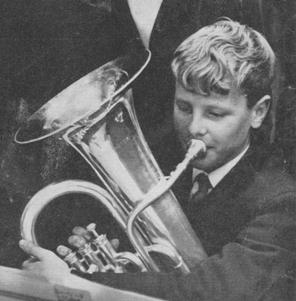
I was interested in joining the high school brass band but I didn't want Mum and Dad to know, because I didn't want to trouble them for the 80c per week instrument rental fee. However when they found out they insisted that they could afford it. This was at a time when a sausage roll cost 8c in the new decimal currency. I chose to play the euphonium, which is the same pitch as a trombone but has a sweeter sound because it has wider tubing, and is often given melodic parts to play. I did not want to play the trumpet because I have always been more interested in the harmonies than the tune.
When the band became a military band I helped them out by transposing trumpet parts into concert pitch for orchestral instruments like flutes and clarinets. Military band parts for euphonium, unlike trumpet parts, are written in concert pitch on the bass clef. Having played brass band euphonium parts for five years, I was used to reading C on the treble clef and playing C. Now I was expected to read C on the bass clef and play D! I was never able to sight transpose military band euphonium parts quickly enough, and had to rewrite my parts in brass band pitch.
In early high school I decided I had to own a bass guitar, so I pestered my parents for paid household chores. When they saw my determination, and after I was already part of my first band in 1970, they bought me one and an amplifier to go with it.
The band I had formed with my best friend, and with other members of the school brass band was called The Combination, with
- Phil Street - trumpet
- David Costello - trumpet
- Geoff Jessop - Trombone
- David Jack - drums
- myself - bass
Later in the year when we were still 14 we entered a talent contest at Westfield Hornsby, and were selected for two channel 9 TV shows.
The first was the Super Flying Fun Show, which was on every Saturday morning, hosted by Marilyn Mayo. For a time, this show had young entertainers on each morning. We played Night Train - a traditional jazz number - complete with a not so traditional fuzz box bass solo, and the band was paid $8.
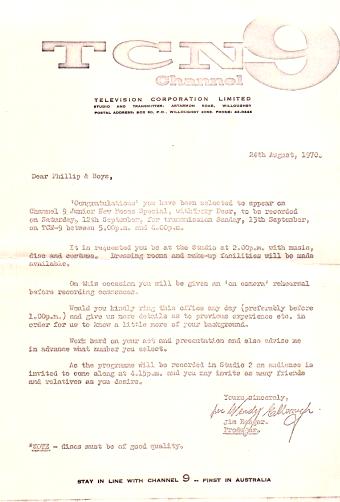
The second show was Junior New Faces. We wore our school trousers with light pink shirts, because we were told that pink came out whiter on black and white TV than white did. The most memorable moment of the show for me came after a plump boy contestant had sung Yesterday, with the line "Suddenly I'm not half the man I used to be". One of the judges mused out loud, in front of hundreds of thousands of TV viewers, if he's half the man he used to be, how big was he before?
We played Galveston, the Jimmy Webb classic which was a hit for Glenn Campbell, and we were paid $20. With no chordal instrument in the band, I attempted to fill in the gaps in our sound with lots of bass notes and arpeggios. We weren't very good and didn't win.
Each school holiday we would set aside a full day's rehearsal to run through new songs I had written arrangements for, and we would share a packet of Benson and Hedges cigarettes between the five of us. After this once a term taste of rebellion I don't think any of us actually took up smoking.
Later in high school there were some personnel changes (new drummer, added guitarist) and we changed our name to The Brass Hinge. Our final performance was at our year 12 speech night at high school.
More band experiences
By the end of 1970 I was gigging with a band led by an organist called Gary Parsons. We wore white shirts with blue ties and grey trousers, and were booked for corporate events and other occasions like weddings. We had no vocalist - Gary played the organ as a lead instrument. We played well known numbers like Zorba the Greek, Running Bear, and other party favourites. We got good money too!
I also sang and played bass in a five piece vocal band called Canopus with one of my good friends, Neville Melbourne. The band played church coffee shops and the occasional church service. We played songs by Bob Dylan, Joan Baez, Neil Young and other youth protest songs, as well as semi-religious numbers, depending on the venue. Any money earned usually went towards petrol. Neville and I spent many Saturday afternoons playing our acoustic guitars along with Beatles records, and we would occasionally perform as a duo with our acoustic guitars.
I also sang with my Dad in the church choir at Easter and Christmas, when we would present oratorios like Handel's The Messiah. When we rehearsed and performed Hodie by Ralph Vaughan Williams some of the more traditional choir members struggled with the unconventional harmonic and rhythmic elements, but I was excited by them.
At the end of Year 12 I played electric bass and double bass for Oliver, which was the first musical production by my school.
For a time after I left school I played double bass with Lane Cove Municipal Band, travelling to the Gold Coast in my first plane trip to compete in a band competition playing Gustav Holst's First Suite For Military Band in Eb.
Later that year I returned to my old high school this time as a paid instrumentalist to play double bass for the musical Toad of Toad Hall. It was exciting to play in the orchestra pit of a theatre for a profesionally presented musical.
A year later I played double bass and electric bass in a trio along with a teacher on piano and Rob Hirst on drums for a local high school's production of Kiss Me Kate.
Turramurra jamming
Around the same time that I started playing in these bands I was learning tennis with Rob Stevens, who would later become the proprietor of Turramurra Music Centre, and Chris Hodgkinson, who would later help to organise the first Farm summer tour.
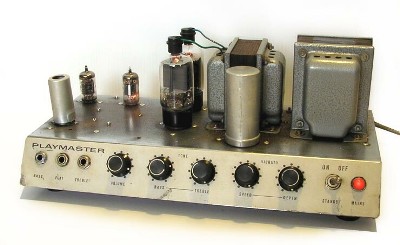
Rob owned one of the few guitar amplifiers in the Turramurra area. I believe that he played piano at that stage. He would later play bass. Chris lived around the corner from Rob and played electric guitar.
Most Saturday afternoons, like minded teenage boys from private schools with aspirations to stardom would meet in some unsuspecting Turramurra home, and guitar cables would compete for the opportunity to plug into one of the three inputs on Rob's amplifier.
Rob or Chris had seen me on TV, so they knew I had a bass amplifier and could play. Their usual drummer sometimes had to play cricket and come to the jam sessions late, so one Saturday they invited me to sit in on drums until he arrived. I knew I could keep a beat as I had occasionally had a bash on the drums at Brass Hinge rehearsals. I played drums at this jam session until the usual drummer came back from cricket, and then I stayed and played bass.
While it is not likely that Jim Moginie was at this first jam session, it was in connection with this group of musicians that we met. I believe initially Jim didn't own a 'proper' rock instrument, bringing a reed organ with him, but he soon splurged $35 to buy his first electric guitar, which served him for the next few years.
At this stage I didn't even know Jim's name. He was known to me as Mog. The first time I rang his home his mother asked whether I wished to speak to Jamie or to Kim (his brother) and I didn't know!
First gigs
The first public performance in early 1971 of this collective including Jim was at a scout hall, as one part of the evening's entertainment. The adolescent musical collective gathered at the scout hall that afternoon, after borrowing a second amplifier from an older musician. We didn't have a name, or a list of songs, and I didn't even know who was actually going to be in the 'group'.
By that evening many of the collective had staggered off in search of other distractions, leaving behind those who were there for the music. We were introduced as "The Purple Link", and from memory played some Beatles songs. We had a girl singer, and I'm not sure who played guitar, but the drummer couldn't keep time, blaming the strobe lights for interfering with his timing. The older people in the audience were not impressed and put their fingers in their ears, but it would have been quiet by today's standards. I believe Jim may have played some form of keyboard.
My significant memory of this evening was after the gig, when Jim and myself and the girl singer sat on the back steps of the scout hall and sang Beatles songs in three part harmony. I had never before met people who could naturally harmonise like I could, and I really enjoyed singing with them.
These informal gatherings of aspiring rock stars continued for some time, with a variety of boys turning up each Saturday. I don't remember any girls playing at the jam sessions, although some came and listened. As far as I know, I was the only public schoolboy at the time, although later Rob Stevens would complete his senior high school studies at Turramurra High where I was. Rob Hirst would have been recruited through his connection with Sydney Grammar, where I believe he played snare drum in a pipe band there. My diaries indicated that we started rehearsing with him in the second half of 1971.
Over time the collective coalesced into two bands. The first, initially called Schwampy Moose, was Rob, Jim, myself, Chris Hodgkinson on guitar, and John Royle on flute. The second band was Topaz, who would get as far as playing their debut single (a non-original number selected for them by their record company) on Countdown.
Schwampy Moose's first gig was at Shore, as a lunchtime event for the students at the end of 1971. I was so shy I coudn't raise my head to look at the audience. I started to raise my head but someone threw an apple core which hit my bass, and I kept my head down looking at my feet for the rest of the concert. Rob was the only singer at that stage. One of the songs was I'm a Loser by the Beatles. The vocal in this song starts without accompaniment, and Rob started in the wrong key. Once the guitar came in he quickly adjusted to the correct pitch, but a teacher came in from the staff room next door, interrupted the concert and told us to turn down. We restarted the song, and once again Rob started in the wrong key. Chris had a music stand for his sheet music - not a very rock and roll look.
It soon became obvious that Chris didn't contribute a great deal to what we were doing, so we started having rehearsals without him.
John was more musical than Chris, but we were getting rockier and flute was less and less able to fit into the music. He graciously chose to leave the band, and took up bass in another band.
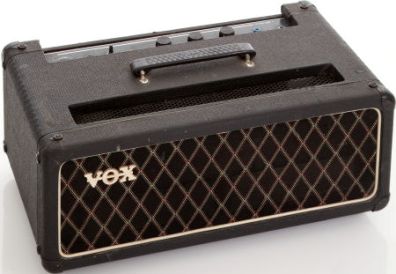
One of my early experiences with alcoholic drinks was at a school house party at Barker. I was given an orange drink which was rumoured to have vodka added to it. Being the cautious and naive type I chose not to drink it and placed it on top of my trusty Vox valve bass amp. It tipped over and spilt orange juice over the valves, which was quite an expensive accident to repair.
Misfortune also struck Rob Stevens, who was the bass player in the next band on the bill. His bass, a old semi-acoustic Maton, had a dodgy connection. I had to leave at that stage as my Dad was waiting, but I heard he ended up playing his bass lines on a borrowed 6 string guitar.
The band was now a three piece. Rob, Jim and I called ourselves Sparta.
At a rehearsal at Rob Stevens house, Jim was trying out a new chord progression, over which Rob Stevens was singing questionable lyrics. For a long while after that the largely instrumental piece was known as 69'erland. It morphed into a piece called Eye Contact, which was regularly played in early Midnight Oil performances, and was a candidate for the second Midnight Oil album. However although we tried several different styles and arrangements as we prepared for recording, we couldn't get it right and so it was not actually recorded.
Until we were old enough to drive ourselves, our dads had to drive us everywhere, and had to wait up late to pick us up from the gigs we played. I know my Dad breathed a sigh of relief when I got my licence a week after my 17th birthday. I had failed the test on my birthday (I got flustered and stalled the car at an intersection). The examiner said "See you next week". The next week we drove around the block (and I forgot to wear my glasses) and he gave me my licence.
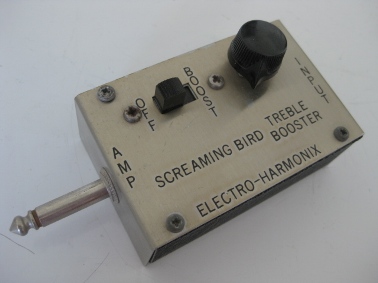
In the early part of our final years at high school we played a concert at Grammar with another band named Gunja. The guitarist in the band was Martin Rotsey, and the singer was Mike Deep, who later went on to play bass with Kevin Borich. I can't remember who the bass player and drummer were, but I believe they all came from Grammar. Martin played a yellow Yamaha guitar in a Hendrix'y, bluesy style, quite different to Jim, who by this time was listening to some quite challenging music (Yes, Focus, ELP etc, while still retaining a love of Beatles and interesting pop, like Todd Rundgren). Mike had a raw gravelly voice and in the following year would be our vocalist when we entered a band competition. Many of the bass players that Jim was listening to played with a treble-y tone so as an experiment at this concert I played bass at this concert through a treble booster.
Towards the end of that year we played another concert. Gunja may have broken up, but anyway, Martin and Mike joined Jim, Rob and me to form a one-off 'supergroup'.
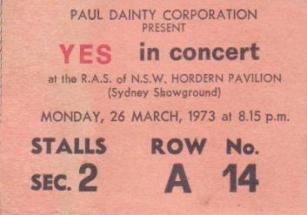
Jim introduced me to some amazing bands (for example King Crimson) and concerts (for example Yes). We would find new music and swap cassettes or records with each other. We would spend hours in music shops trying out the latest gear (for example, the Minimoog) and taught ourselves to play the difficult parts on the records we listened to.
We would soon change our name to Farm, and that opened up a new chapter in my life.