The Oils
Consolidation
In June 1976 we changed our name to Midnight Oil, which had more street cred and sounded less agricultural than Farm. Tired of the commute from Canberra, Peter moved back to Sydney, and transferred the remainder of his courses to NSW Uni.
The experiment with Peter Watson on keyboard came to an end, but not before an interesting incident was captured on tape at one of our gigs. When we replayed the tape of the gig we could hear little Hammond organ bleeps in a bluesy song which shouldn't have had keyboards. We couldn't figure out why, until it was remembered that Peter had cut his finger and the bleeps were the sound of him wiping his blood off the keys.
From the sidelines
Towards the end of 1976 we were a four piece again. The band were keen at this stage to leap into the unknown and turn 'professional'. Rob was completing his Arts degree and willing to stop before he did his Law degree. Jim was completing his Science degree. Peter had already completed his Arts degree and was midway through his law degree. However I had done three years of Economics and I intended going on to my Honours year. I was asked by the band to discontinue my studies and concentrate on the band. My parents were upset that I was even contemplating such a step. I thought the chances of Midnight Oil providing a career for more than a few years were slim, and that I would forever regret not finishing my degree. I could also see that the time had not yet come where we could earn a living from the band.
Telling the band that I would not agree to ditch my university studies was difficult, and I think this upset Peter the most, as he had already given up the most for the sake of the band. They said that if I would not give up uni, they would have to go 'professional' without me.
Shortly after this, I was diagnosed with a chronic eye condition which continues to be a problem for me whenever I use my eyes a lot. The study for my third year exams had caused my vision to deteriorate so that I could no longer study. One month before the final exams I had to discontinue my courses at uni, and on advice from a specialist, I moved to the country (Bathurst) to stay with a family we knew, to give my eyes a chance to recuperate away from pollutants. One of his other patients had recovered quickly when she became pregnant. This option was not available to me.
This break didn't really work, as two months into my country stay I got a bad dose of bronchitis, and any improvement my eyes experienced was lost. I was interested to see if two months without loud music would stop the constant ringing in my ears. It didn't. However, it did give me opportunity to investigate Gospel music more fully, as the children in the family I was staying with had a collection of albums by inspired Christian artists like 2nd Chapter of Acts and Keith Green.
I returned to Sydney, and started Uni the next year, repeating my third year.
My leaving Midnight Oil caused a re-evaluation of strategy and lineup. Martin Rotsey, who was already known to us as a guitar player, joined on bass. Murray Cook (not the red skivvy wearing Wiggle) joined on keyboards and flute. For one set of each Midnight Oil performance Murray would play bass, and Martin would play guitar.
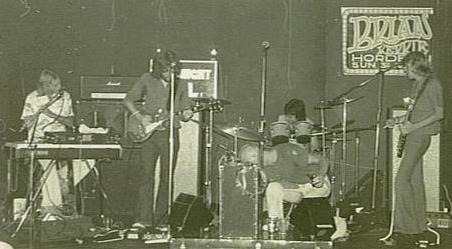
Since I was available and knew the music backwards, I became the PA operator. My strong point was having a musical ear. However, this doesn't help when one member of the audience comes up to you and says "the guitar is too soft", and another tells you "the guitar is too loud"! This taught me to go with what you believe and not to be swayed by public opinion.
My weak point was that it took me so long to set up. As the band were too loud for just one PA, I had to set up two separate PA's and two separate mixers. One PA was rented from Peter Vogel, who was one of the team developing the Fairlight CMI (Computer Musical Instrument), the first commercially available sampler and sequencer. The other PA was rented from Geoff Bullock, who I would later connect with and record albums with at Hillsong church.
The band adapted to the limited setup time they had by playing a largely instrumental first set. The first PA was used for the instruments, and the second PA used for the vocals. After the first few instrumental numbers I would have the second PA ready to rock.
Midnight Oil - back in the saddle
After a while the band re-evaluated their lineup options. They were happy with Martin's bass playing but it was a waste to have such a fine guitarist on bass.
One event which helped them reconsider their lineup was a gig at the Narrabeen Antler, when the band invited me from the mixing desk to the stage to play bass. I would like to think that I can inject an element of energy and excitement and at times a slight lack of discipline into any song I play. Perhaps it gave Rob and Jim a kick and pushed them a little harder. Anyway the band must have liked what happened. Soon after this they invited me to participate in several rehearsals where the role of each musician was flexible, as we could all play several instruments. Some consideration was given to me being a replacement keyboard player for Murray, but this was pushing me into playing an instrument that I was not as proficient at. It seemed much more sensible to let Martin play guitar and me play bass. Jim knew what keyboard parts he wanted played, so it seemed sensible to let him play them. Soon we settled into playing our main instruments, with me playing bass.
Murray would go on to play guitar, bass and keyboards with a number of other bands including Warumpi Band, Mixed Relations and Mental as Anything.
By this stage it seemed like I was going to be able to finish my degree in 1997. I was no longer enjoying Economics and no longer wanted to do an honours year or follow a career using the degree. This new Midnight Oil lineup had more promise, and so in 1978 I was willing to turn 'professional'.
1978 was the first year of being 'Professional', but this was in name only. The reality was quite different. Jim took a job with the CSIRO doing some acoustic engineering research. Peter still had one final semester of Arts/Law to complete. Rob worked in a sports complex with squash courts. My only job was teaching guitar to underpriviledged children at a Barnardo's home, a job which was passed on to me by Jim.
One association which was later to create difficulties was with Chris Neale. Chris ran Airborne recording studios at the back of Farrells Music, at Brookvale. I don't recall how the connection was made, but he asked us to come in to his studio and record some songs in 1977.
According to Chris, the band made a verbal statement that we would ask him to produce our first album. This wasn't the band's understanding. My recollection was that it was to be a time of mutual learning - Chris learning how to record and mix a rock band, and us getting studio experience. Later Chris would serve writs on the band members when he discovered we were not considering him to produce our first album, but without anything in writing his chances of being successful with the law suit were slim, and he did not pursue the case.
One of the songs we recorded was a song by Rob called Crystal Radio. Rob would later turn down the offer of a publisher to buy the rights to that song for $50. I learnt from Midnight Oil never to sign away the ownership of your songs.
It is possible that Peter was getting dissatisfied with his hair. Normally blond, long and thin, suited to his surfie leanings, he started experimenting with different looks. His final attempt at a hairstyle was a short perm which was not my favourite. Perhaps he decided to solve the problem entirely by shaving it all off.
I first saw this new 'look' when I arrived at a gig somewhere down south, and Peter was already there, perhaps a little selfconscious. This was at a time when people with shaved heads were extremely uncommon, regarded with suspicion, and thought likely to advocate violence and anarchy. However, it didn't take long for all of us to become accustomed to it. At one stage it was even being discussed if the remaining band members should follow suit.
Building a fan base
We arranged a bank overdraft to smooth our fluctuating income against our constant living expenses. As the band were making very little money, we each got paid according to our weekly needs, as we couldn't afford to pay each member the same amount. Martin got the most, as he had rent to pay for. I got the least - a token amount of $10 per fortnight. I was still living at home, and my parents helped me out by not charging me board until I started getting more money.
At one gig at the Antler (Narrabeen Sands) this guy came up to us after the gig and started talking to us about how great we were and what we should do. To me it was like another dialect, talking in words familiar to those in the surfing and drug culture, and possibly stretching the truth in places. From memory he was selling cars or real estate or whatever he could lay his hands on to sell. At the time we weren't going to refuse any offers of help. His name was Gary Vasicek, and we were soon to refer to him as Wazza.
Our regular haunts were French's nightclub (in town) and the Antler (at Narrabeen). Other gigs were soon to be added - the Charles hotel at Chatswood, the Rex at Kings Cross, Knights Inn with waitresses in see-through blouses etc.
A professional band has professional equipment, and a loan was arranged with a local bank to buy some decent equipment, including a bass amp. With two guitarists on stage, my old equipment could not cope with the new volume levels we were playing at. We also got a truck, which would prove to have been a bad investment when we sold it at a loss not long after.
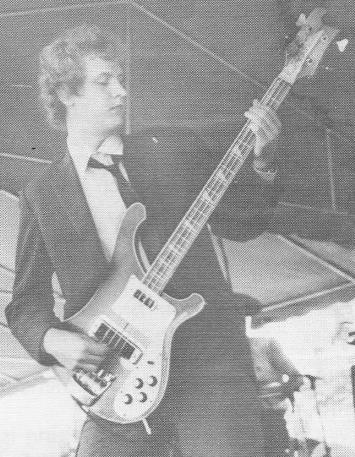
The costs of putting on a professional show and paying ourselves our meagre allowances were more often than not greater than the money we earnt from the gigs. At the end of that first year we were $20,000 in debt. Bands we supported in this time included Mother Goose, John Paul Young, Taste, Dragon.
The band continued to write songs to add to our live performances. Jim had a Teac 4 track tape recorder to record his songs on. I only has a 2 track recorder at that stage which I found limiting, so I got a loan from my dad and I also bought a Teac 4 track. Sometimes Jim and I would use both recorders together. I often had equipment in the back of my car after gigs, and so my recordings used Jim's Micromoog, his Melos echo, and his Gibson Les Paul. Under his house Jim had a drum kit and an organ, and so I added organ, drums and acoustic 12 string guitar to my recordings at his place. I respect solo artists that can play all the instruments on their records, and that's what both Jim and I did on our early recordings.
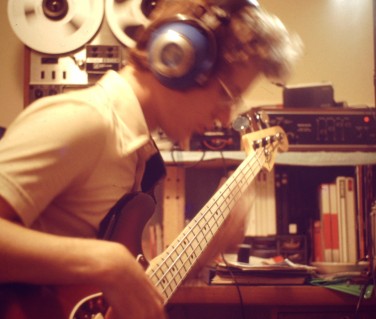
Jim was a prolific songwriter, and would produce a tape reel of completed songs several times a year. You can never be sure where songs will end up. From Jim's early tapes in 1978 and 1979 came the music for Blue Sky Mine complete with 12 string jangle, included on Blue Sky Mining 10 years later, and Blot, included on Redneck Wonderland 20 years later.
Although the band did play early versions of my songs (my song, The Visitor, was played onstage as T Bear's travels), only two of my songs ended up being used on Midnight Oil albums. The first instance was a pre-chorus section in my song Lemons which was used for the bridge in Powderworks on the first album. The second instance was my song B.B. where Jim simplified the verse chords, Peter rewrote the lyrics, and it became Back on the Borderline on the Head Injuries album.
Band meetings for me were an exercise in frustration and anger management. Often the band and Gary were pulling in different directions. Once Gary had made up his mind what had to be done, even if the band categorically forbade him to do it, it was difficult to prevent it from happening. The fact that we didn't have the money didn't stop Gary - many cheques bounced in those early days. Gary seemed to use the chequebook like a credit card - he took the chance that money we didn't yet have might turn up in time to stop the cheques bouncing. I didn't cope well with conflict, and band meetings certainly had a lot of that.
One significant gig for us was a live to air concert from the 2JJ studios early in 1978. Keith Walker was the engineer for this concert, and pulled an impressive sound out of an inexperienced band. He was used to live bands and so became the frontrunner when it came to looking for engineers for our first album.
Peter completed his Arts/Law degree in mid-1978. It was now time to get a recording contract. All we had to do was find a record company. I don't recall who all the candidates were, but I do remember representatives from several record companies coming to see us at French's nightclub. We visited Michael Gudinski at Mushroom Records in Melbourne, but having recently experienced disappointing results from letting bands make their own creative decisions, I don't think Mushroom were willing to give us the control we sought.
The "Blue Meanie"
At the time, TV's channel 7 were looking to branch out into 'pop' records. Whilst they did not have much expertise, this worked to our advantage. The level of control they were offering us was attractive, as was the percentage royalty rate. We could choose our artwork, our video producer, our music studio and producer, and even our label name. The other band they signed at the same time were Ol' 55, with Frankie J Holden & Wilbur Wilde, for whom they created the Street Records label.
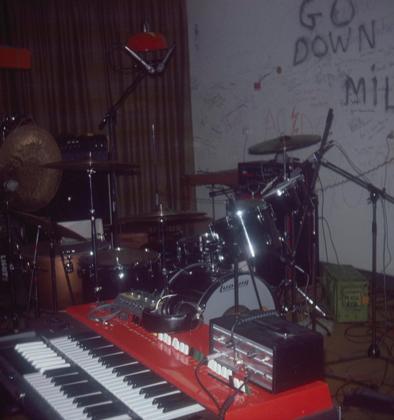
So in late June 1978 we signed the contract. We chose the label name Powderworks (a name many think to this day is the name of the first album), and recorded the album which is sometimes referred to as The Blue Meanie. We recorded it in the smaller of two studios at Albert Studios, where AC/DC recorded some of their most famous early songs. When we first looked over the studios, Harry and George (my idols from Easybeat days) were in there, with George behind the mixing desk, and Harry laying down a woodblock percussion track. Each time Harry got tired and slipped out of rhythm, George would rewind the tape and drop in from that point. Various iconic instruments were casually lying around - a Gibson Les Paul bass here, (probably the one George used when he played bass for Stevie Wright at the Opera House), a Hohner Clavinet there (probably the one used for Love Is In The Air, etc. Each instrument would have a story to tell and each was probably used on well-known tracks from the Vanda/Young hit factory for artists like Stevie Wright, John Paul Young and William Shakespeare.
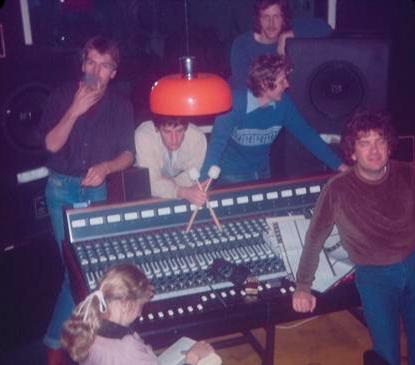
We recorded the basic tracks for the first album in 4 days, with some guitar overdubs on day five. All the vocals were done by Peter, while I took a break from the studio. I came back from holidays for the overnight mixing sessions, which were held in the larger of the two studios. To Keith Walker's dismay, the bass wasn't as prominent or as deep in the monitor speakers in the main studio as it had been in the monitors in the smaller studio. Some tweaking was necessary to try and put back some bottom end into the recording. Also, the sound of the cymbals when played back lacked that sparkle they had when they were recorded, so a judicious amount of Aphex aural exciter was needed to bring the sparkle back. We used perhaps too much Eventide harmoniser on the guitars, but it was in fashion at the time. The mixing sessions were from midnight to dawn, and I have a lot of respect for people who can remain objective for hours at a time listening to one track over and over - I couldn't.
Promotion
The film clips for the first album were shot on the stage of the State theatre in Sydney which we had booked from late night to early morning. Three songs were filmed - Used and Abused, Run by Night, and Nothing Lost, Nothing Gained. The first two were straightforward mimed band performances. The third clip was 'arty'. We shot the band bits that night, but the completed film clip began with shots of suburban Australia, including people pushing lawnmowers. The band didn't appear in the clip until several minutes into the song. I liked the clip, but I seem to remember that many didn't.
We drove home that morning for a few hours sleep, and had to return to the same theatre that night where we were supporting Cold Chisel. Back then Jimmy had a formidable voice, which in my opinion isn't anywhere near as good now. Along with Ian Moss's always impeccable blues voice and guitar they were a terrific band.
Having a record out meant that:
- We got a small advance from the record company.
- More people came to our gigs, so we could raise our fee.
- People knew the words to the songs that were on our album and sang along with them.
- We got asked to play on Countdown.
The original collective of musicians in Turramurra had congealed into two bands. One was Midnight Oil. The other band was called Topaz. Several members of Topaz used to work or teach at Rob Steven's music shop, where I often used to hang out. They would brag that they were going to appear on Countdown before we did. Topaz signed a contract with a record company to record a single, and if that was successful would be invited to record an album. The B side for the single could be their own composition, but the A side was a song chosen by the record company. Topaz did get to perform the song on Countdown, but the single didn't set the world on fire and they were dropped by the record company.
If circumstances had been different, Midnight Oil would have been on Countdown first.
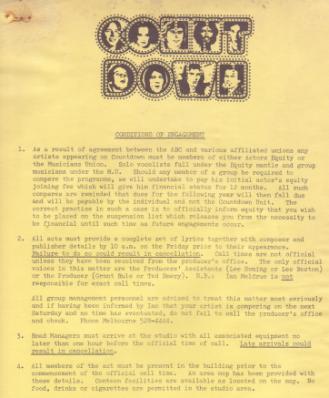
The Countdown weekend started began with me catching a gastro bug from my young niece and nephew on Thursday morning 5th April 1979. Although I didn't throw up like most of my family I had bad stomach pains and diarrhoea. I played the gig at the Comb and Cutter that night sitting on a stool. Friday night was the Bondi Lifesaver, with Rose Tattoo as support. I got home at 3:00am in the morning, and had to climb into the taxi at 5:15am to be at the airport at 7:00am. We caught the 8:30am flight to Melbourne.
We arrived at our regular hotel, The Majestic in St Kilda, and promptly went to sleep. The Majestic had the cheapest rooms in town, and was populated almost entirely by old people who were permanent residents. In later tours we would upgrade our accommodation to a slightly less seedy hotel around the corner called The Diplomat. Gary went off to Countdown to see if everything was OK.
Countdown had set up a blue set for us to perform Run By Night from our first album. However, they expected us on the set at 8:00am and we were sleeping instead. Gary was a cocky young buck who thought he could talk anyone round given the chance. Words followed between Gary and Coundown staff, with the result that another band was enlisted to appear on the show in place of Midnight Oil that day.
We played the Bombay Rock that night, where Molly Meldrum sometimes came to see bands, and I expect that Peter gave Molly Meldrum a serve, as he usually did at that venue.
The line that "Midnight Oil refused to play on Countdown" wasn't quite true, but it made good press.
Supporting
We played with many other bands at this time, initially supporting them and later headlining our own shows. We played with Dragon (great band when they were firing, but often they weren't), Mi-Sex (who we could blow off stage when we were hot, but if we weren't, they could blow us off stage), Mondo Rock, Split Enz, Skyhooks (after Shirley and Red left), and the Sherbs, who were no longer as popular as they used to be and were now playing small pubs to a handful of people. A lot of people missed an opportunity to see one of Australia's best bands playing some of their finest music because they weren't considered 'cool'.
One memorable gig for me was at an old picture theatre at Manly, called Flicks, in May 1979. In what was arguably an inappropriate choice, Air Supply was supporting Midnight Oil. At the time Lost in Love was climbing the charts on its way to number one. Our audience didn't want a bar of this 'love ballad' band, and chanted "Oils" and threw things on stage. I was ashamed - Air Supply were great musicians and really rocked that night. The album which they were supporting at the time, Life Support has some great rock numbers. However it was the love ballads which brought the money in, and the band's future direction would be locked in by the success of Lost in Love. Many years later I would record a worship album with their guitarist David Moyse. God caught up with him on one of Air Supply's American tours, got him clean from drugs and turned his life around.
Another band who supporting us was the Farriss Brothers. My initial impressions of this band was that they were a good band but the lead singer had not yet developed charisma or stage presence. With more experience he would become an impressive front man for the band. Gary our manager would soon take a break from Midnight Oil to manage them. He chose their new name - INXS.
Our stage roadie at the time was called Pig. He was a guy with a loyal heart, who loved bands who "kicked arse". Every second word was the F word, except when he used the C word, and his conversation (complete with actions) often strayed to describing what he got up to with the ladies who followed the road crew.
Pig used to carry a length of sawn off mike stand, with gaffa tape at one end as a handle. He used this as a club to protect himself and protect the band. I used to wonder what the legal implications would have been for the band if he had seriously injured or killed someone. In the early days our roadies often had to leap into the audience and deal with troublemakers. On occasions Peter would also assist in crowd control when he could see people getting hurt. After Pig got into some arguments with our road crew he went to work for his other kick-arse favourites - Rose Tattoo.
I am a conservative, shy and reserved type. Other events which distanced me further from the typical Oils audience were
- An overheard comment by a punter that the measure of a successful weekend is how little of it you remember when you wake up out of your drunken stupor on Monday morning.
- At the Antler one night directly in front of me, an ecstatic punter broke his beer glass and slashed his wrists. I didn't see this, and if I did, probably wouldn't have been able to continue performing.
- Measuring bands solely on their 'kick-arse' factor and not on musicianship.
I was uncomfortable with the title 'rock star'. I used to argue with Rob about when I was on-duty and when I was off-duty. Rob considered that the "role" had to be played 24 hours a day, in clothing, attitude and action. I never did understand what was 'in' and what was 'out', whether this week it was beanies and baggy shorts and long hair or black skintight jeans and short hair. I let the band choose what I wore on stage, but I considered what I wore off stage to be none of the band's business. Rob thought I was letting the band down by not playing the part and wearing the 'uniform' all the time.
Getting down to business
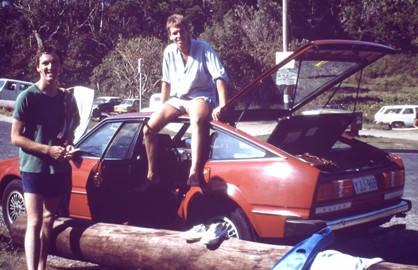
1979 was a year of getting out of the red, which was difficult with Gary on board. We did the Melbourne, Sydney, Brisbane, Sydney, Melbourne shuffle. Usually we were in hire cars, but on occasions we flew. Brisbane usually meant the Gold Coast, and we also did the Sunshine Coast (Mooloolabah) on occasions. Melbourne usually meant gigs in the suburbs, but often an inner city gig or a Geelong gig was included. Sometimes we went to Canberra on our way through, or went to Adelaide. Sydney usually included Newcastle or Wollongong. We were away from home maybe two weeks out of every four.
One interesting gig was at Sylvania in April 1979. There must have been some confusion as to whether the gig was on or cancelled, because Martin didn't show up. We thought he might have gone to the Royal Easter Show with his girlfriend, so we had him paged at the show. However, he wasn't there and wasn't contactable (no mobile phones back then), so we had to refund all the money to the punters, who weren't happy about that.
Head Injuries
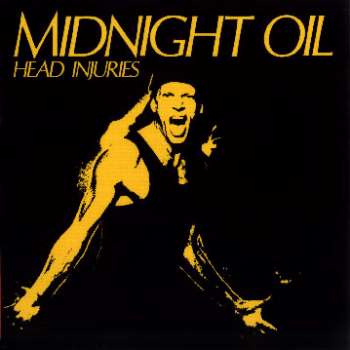
It was time to start considering the next album. During a 2 week break from touring, Jim and Rob, possibly with help from Peter and Martin, put together some new songs from all the pieces that were available. I was on holidays at the time and so did not contribute in person to the process, although as previously mentioned, one of the songs I had recorded was finessed into Back on the Borderline.
The producer we chose for our second album was Les (or Lez) Karski. He was a key figure as guitarist, songwriter and producer in the early days of a British white funk band called Supercharge. He had jumped ship on one of their Australian tours. Les would later go on to produce albums for other Australian artists, for a time be part of the Alberts team with Harry Vanda and Georde Young, and play guitar or bass with a number of bands, including the Hippos and the Bondi Cigars. Lately he has played with a variety of visiting blues acts, and has been performing with his own Les Karski band.
We tried out Paradise studios in Woolloomooloo, which had just been set up by Billy Field. Alan Lancaster, former bass player from Status Quo, assisted us on this occasion. A year later, Billy would record his mega-hit album Bad Habits in this studio, but at this early stage Les thought the sound wasn't quite right, and he kept looking. Les eventually chose Trafalgar studios in Annandale, with Peter Walker (no relation to Keith Walker who produced our first album) engineering. Peter had recently engineered the Air Supply album in that studio with Charles Fisher producing. It became evident at this session that my Rickenbacker bass was not keeping up with the dual guitar onslaught of our newer material. Each year found me playing harder, which my Rickenbacker did not respond well to, with a tendency to lose the fundamental bass frequencies leaving only clatter, and when under stress to break strings at awkward moments.
With Les's help we knocked the songs into shape at Now studios, a rehearsal studio with a four track tape recorder available for an extra fee. One of the live favourites which we were considering recording was Eye Contact. Les had in mind some changes to the feel of the track, including a funky bass line which he showed me how to play, but it didn't work as a Midnight Oil track. Unlike the first album where the songs were all lifted from the live set, we were able to record tracks for the second album which would never get played live. Naked Flame was one of these. Rob and I multitracked falsetto backing vocals in the studio, but it didn't sound as good when we sang it live.
At the pre-recording sessions I was playing a Fender Precision bass in place of my RickenbackerWe had a collection of guitar amps and speakers sent to the studio to see if any would produce the sound we were after, but nothing worked. In the end, Jim bought new speakers for one of his Marshall quad boxes, and Martin used a vintage Vox AC-30 which Peter Walker the engineer owned.
After much pressure from the band I had bought a Fender precision bass, but just like the Rickenbacker before it, this bass also just disappeared from the mix when the guitars started roaring. Martin's L series Strat in particular had a lot of bottom end to compete with. The solution was to rent one of the newly released Music Man Basses, which had enough solid bottom end presence to anchor the band's sound. In a twist of fate, this bass would later be stolen from Turramurra Music. (I didn't take it, honest!). In retrospect, I should have made the effort to borrow the cash to buy it, as those early Music Man basses sounded terrific and are now highly sought after.
Setup, gear selection and recording backing tracks took about 2 weeks. The recording approach which seemed to work best was to play the track again and again. The first time we played it it would have heaps of energy but be sloppy, and with each successive performance it would get tighter and tighter but have less energy. We would then take a half an hour break or so, and come back and usually nail the track with a take which was both tight and energetic.
This worked for most numbers. However, Stand In Line was a great song which we did not do justice on the album. In my opinion a better version of this song was recorded live at Parramatta Park, with Peter Gifford on bass, and included on the Scream In Blue live album.
We also recorded I Don't Wanna Be the One for Head Injuries, but there was something lacking in our performance and was left off the album. The song was rerecorded with more success for Place Without a Postcard and became the first single from that album.
The overdubs of the the three little one-bar bass breaks for Bus to Bondi were done after the Music Man bass had gone back to the shop, so I used my Fender Precision bass for them.
After the backing tracks and all the instrumental overdubs were completed Peter was called in to do the lead vocals. Les and Peter Walker recorded several parallel tracks of lead vocals for each song. I did harmony vocals on a number of songs.
On Naked Flame Rob and I sang each falsetto line together twice, meaning that there were eight voices. Les then added some effects to make them even smoother.
The last overdub recorded was my harmony vocals for Koala Sprint. They were recorded after a gig at the Stage Door, and were finished close to 9:00am in the morning. I then had to drive home in daylight and try and get a few hours sleep. That evening we took the 5:30pm flight to Canberra for a gig that night. The next morning we flew to Melbourne for a week, and then flew to New Zealand via Sydney airport. Peter Vogel was also on that flight to New Zealand, on his way to America to demonstrate the Fairlight CMI to Stevie Wonder and other musicians. Les Karski and Peter Walker were left to construct an album out of the raw recordings they had made. The band wouldn't hear the result until we returned from New Zealand.
"Overseas" touring
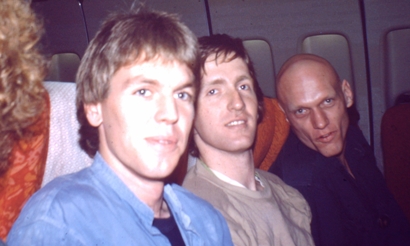
Before we could bring our equipment into New Zealand we had to pay a rather large bond (several thousand dollars) to deter us from selling our Australian equipment to the New Zealanders for a massive profit. All the gear was checked as we left NZ to make sure we hadn't sold any of it. Tariffs were high in New Zealand, and many things, like cars and electrical equipment, could cost twice as much in New Zealand compared to Australia.
While in New Zealand each band member was payed a salary of $NZ50 a week.
New Zealand was conservative. The audiences didn't know what to make of us. We met up with the Dudes (with Dave Dobbyn), and saw Jenny Morris's band, the Wide Mouth Frogs. Also touring at the same time were the Swingers (Phil Rudd - ex Split Enz, with Bones Hillman on bass).
We played one concert in Auckland which was meant to be televised - a bit like a battle of the bands with Australia vs New Zealand. We struck two main obstacles - firstly all our mikes were plugged into the wrong channels (which our road crew suspected was sabotage) and which made us well behind schedule, and secondly the TV crew were only booked until a certain time, and when that time came they started to pack up all their lights and cameras (most of the lights that night were theirs). After extensive negotiations the TV people in charge were persuaded to pay a little overtime and not pack up mid-concert.
We had rented a truck and a mini-bus for the tour. One of Peter's friends from Canberra, who I think was the drummer from Peter's pre-Farm Canberra band, drove the mini-bus. We played about a week's worth of gigs around the north island, visited Rotorua on the way through, and drove into Wellington on a sunny and still afternoon. The ocean looked beautiful, and I wondered whether I had made the right decision to blow my week's salary on a plane ticket from Wellington to Christchurch.
However later that night a wind blew up, and the morning was grey and blustery. The taxi dropped the rest of the band off at the ferry early in the morning for their sea trip to Nelson, and I continued to the airport.
I was already nervous, and took several travel sickness tablets in anticipation of a rough flight. When I got on the plane the air hostess was spraying the plane with air freshener to cover the smell of vomit - not a good sign. When we were on the runway the air hostess couldn't close the door - it was too windy - and she had to get the co-pilot to help her. However, the flight was amazingly smooth. We reached cruising altitude very quickly, and we flew above all the turbulence.
I went to the hotel and Christchurch where the rest of the band in the mini-bus was to meet me, and settled down to sleep off my travel sickness pills. At 10pm that evening I gave up waiting, got a room at the hotel and went to bed. Around midnight the bus arrived at the hotel to pick me up. I was told that the boat crossing had been a horror trip. Whilst none of the band or crew actually threw up, most of the other passengers did, and the road from Nelson to Christchurch was long and winding. Martin later told me he felt very ill for a large part of that day.
We drove through the night from Christchurch to Dunedin, in danger of running out of petrol as there were no petrol stations open on our way. We only made it by travelling slowly and coasting down all the hills. We rolled in to Dunedin as it was getting light. The place we were meant to stay had assumed that we weren't coming and had booked our rooms to other people. After some words were exchanged, the proprieter managed to hurry some early leavers out of their rooms so we could sleep.
It was in Dunedin that Peter would visit a chiropractor for the first time. Being the tough guy he was he didn't tell the guy it was his first time, and after Peter's neck and spine had been realigned his body reacted badly by making him feel very ill for the rest of the day.
In Queenstown we ski-ed. I didn't know what to expect and didn't have proper ski clothes, so I wore my pyjama bottoms under my jeans for warmth. As it turned out, I was too hot. For the previous week the snow had melted in the sun during the day and frozen into ice at night, so it wasn't really ski-ing, it was more like ice skating. I had never been ski-ing before and couldn't afford lessons, so I followed a ski class at a discreet distance and tried to listen in to the advice. I have been ski-ing since and now know that the icy conditions would have made learning to ski very difficult.
I thought I had blown my ski hire deposit when I unlatched my boot from my ski after I fell over, and watched in dismay as my ski slid down the mountain and out of sight. I had visions of it continuing for kilometers down the mountain, but when I started trudging down the hill I could see that there was a patch of grass which was only lightly snowed over, and the ski's moment of freedom had been cut short by this patch.
I don't like loud parties, and one night in Christchurch the after-gig party was in full swing. I made my apologies and retired to my own room next door. I put in my earplugs, put on my flannelette pyjamas, and went to bed. Half asleep I thought someone was trying to get into bed with me. About half a minute later the party burst into my bedroom and the lights were switched on. There in bed with me was a naked woman! Everyone had a good laugh.
The audiences in Christchurch were more receptive than the ones in the more reserved parts of New Zealand. We had five nights in a row at the venue, and word got around the city that we were worth catching. By the final night the place was packed.
At the last chord on the last song on the last night, Martin took a container of talcum powder, took off the lid, and exploded it into the air. The effect was spectacular with the coloured lights. This was a change from our usual finale, when Rob would stand on his drums with his legs apart, and a roadie would discharge a CO2 fire extinguisher into the audience from between his thighs.
Back in Sydney we took some time off, and then rehearsed our new show with the new songs from Head Injuries.
One interesting circumstance happened at Selinas, in the Coogee Bay Hotel. The band were unhappy with the stage sound with too much bass on stage, and kept on telling me to turn down. Eventually I turned my amplifier completely off, but the rumble of bass frequencies on stage was still too loud. Peter was giving me death stares until I showed him that my stage amp was switched off. A cavity in the ceiling above the stage was capturing all the bass frequencies from the front-of-house and swirling them around, muddying up the stage sound.
Another interesting gig was at Newcastle. Peter had eaten some dodgy takeaway and was in imminent danger of releasing it into the audience. The audience almost got more than they bargained for in the scream Peter lets go of in the last chorus of Stand In Line. Assisted by the judicious medical application of marijuana offered by the audience, Peter managed to hold on until after the show, when he had an out of stomach experience.
Touring, touring and more touring
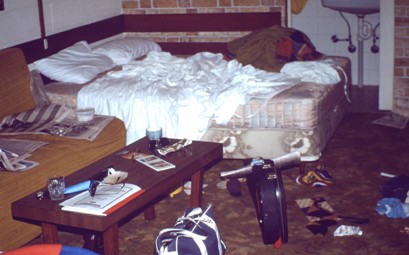
After a few close calls with asthma attacks, towards the end of 1979 we began taking oxygen with us, to be available for Peter or Rob, whose energetic antics needed oxygen, a commodity in scarce supply at venues such as the Narrabeen Antler. We would tune up in the next door section, and walk through the bar to the stage. By the time we got to the stage, our guitars would already be out of tune and dripping with condensation. I had to towel my bass dry between songs. We had several large air conditioner fans blowing stale air onto stage (normal fans did not move air fast enough) and oxygen on tap at the side of the stage. There certainly wasn't much oxygen in the venue by this time we took to the stage, with all the smoking and breathing that over 1000 fans had done for several hours before our performance in a venue licensed to hold 300.
I can recall one gig where we supported Dragon, at the Stage Door tavern. This venue had all the emergency exits chained and padlocked. The only way out of the packed venue was through the narrow main entrance. In the middle of a particularly poignant ballad, Todd Hunter hit a bum bass note, something which was quite out of the ordinary for him. After the song he apologised to the audience, but said that he was distracted by thinking of the catastrophe that would occur if a fire broke out.
At this same venue one afternoon our roadies were setting up our gear, and the lighting guy decided to hang some lights from a pipe across the ceiling. This pipe was a water pipe and it gave way, drenching the stage gear. We couldn't play that night, but we still got paid. One of my bass speaker boxes was made of chipboard, and was never the same after that. Soon after that it got so weak it couldn't hold the speakers, and my dad and I burnt it. Peter Gifford was later to build speaker boxes for the two 15" JBL speakers which came from the damaged box.
God does a number
Around this time Gary Morris was invited to a Billy Graham crusade and God did a number on him. At this stage I was a pretty lukewarm Christian - I carried a bible which didn't read very often, and I went to church when I was in Sydney, but my relationship with God wasn't all that close. I wasn't able to articulate what I believed or why. I had trouble understanding what Gary was on about at the best of times - he was always an extroverted evangelist for some cause, moving way into your personal space and staring at you with piercing eyes. He was too full-on for this rather reserved Englishman. I would just smile politely and uncomfortably and hope that the conversation wouldn't last long.
After his conversion experience he began talking about God using a strange mix of new age/spiritual/druggie language. As I didn't share his background I didn't have a clue what he was talking about. He was certainly excited, and I felt envious and a bit guilty that I didn't share his excitement about God.
Having God in the picture turned Gary's world upside down. He lost his drive and passion for the things he formerly loved, and one of these was Midnight Oil. The band needed someone who could be depended upon to look after our interests and hustle for us, and Gary could no longer maintain enthusiasm for those tasks. He would return to Midnight Oil when he had sorted out how he could work for Midnight Oil and still be true to his new faith.
We were managed for a time by Melbourne manager, Zev Eizik. He was a Jew, which I found interesting, as he observed some rules strictly (for example not driving on the sabbath, because this is making fire in your engine), but turned a blind eye to some other moral instructions contained in Jewish law. I was also amused that he would exercise his dog by driving around the block and encouraging his dog to chase his car.
I didn't have much to do with Zev, as I was shortly to leave the band.
By this time band members were able to draw a reasonable salary. We were paid $175 each per week.
The End
My time with Midnight Oil was drawing to a close. I had not been well for some time. Due to a nervous disposition and a sensitive stomach, I suffered from life on the road. I was hoping to hang in there until we went to England, but my ill health was affecting the band's performances, and it did not give them confidence to organise overseas tours with an ailing bear. When I was ill I had to stand really still on stage and couldn't sing. Each way I turned there was stress, and I was going a little crazy. I developed a duodenal ulcer, and was unable to perform on stage without (prescription) medication for my nerves.
My mother and father holidayed in New Zealand for two weeks when I was on a band break, and although I thought this would be a good break and would get my health back on track, I went a bit unhinged. I had got to the stage where I couldn't escape the stress and the ill health even when I wasn't on tour.
There was no alternative - I had to go. I told the band one night in Wollongong, and the news was received with a mixture of sadness but also relief - they could now get in someone who would be hardy enough for overseas touring. I was to leave the band at the end of our current tour.
The last few weeks of my stay with the band were difficult, but I managed to get through it because I knew that there was to be an end. I spent all day in bed, even lying down before and after performances. The only time I was on my feet was on stage.
I had lost my energy, lost my appetite, and lost my emotional sense of well-being. I was a wreck in all senses of the word.
My physical breakdown
The day after my last gig with the band, in March 1980, was the day they were shooting a film clip for my song Back on the Borderline. It would have been nice for me to have been in the video, but I just couldn't manage it. I could only get out of bed for about 15 minutes at a time before I started feeling very sick. The bass in the song was represented in the film clip by a bass guitar suspended from the ceiling on fishing line.
After I fulfilled my committments Midnight Oil had 2 weeks off. In the middle of these two weeks there was a gig in Canberra. Our manager phoned me up to try and persuade me to do the gig. He said "Other people have ulcers and do gigs. Why can't you?" I didn't know what was wrong with me, but I knew I couldn't get out of bed, let alone play a gig in Canberra.
My Mum and Dad were very concerned for my health. I had no appetite, could hardly get out of bed, and could only manage to eat very small amounts of bland food. After about a month of recouperation I was eating more and able to stay out of bed longer, although I still felt sick a lot of the time. I went to the local shops, but felt really weird - disconnected, like I was watching someone else doing the things I was doing. I really thought I was going crazy.
I went to the doctor, who said that I had clinical depression. He prescribed some short term antidepressants, which I took for a few weeks. These turned me around. However when I felt better, instead of reducing the dose gradually I just stopped taking them. This was a mistake - I felt absolutely emotionally atrocious - different to before. This only lasted a few days and after that I was on an even keel without medication for the first time in months.
Meanwhile Midnight Oil used the 2 weeks break to audition lots of bass players, and had settled on Peter Gifford, not only because he had all the right musical qualities and was a nice guy with a great voice, but also because he pulled a good sound out of his equipment. He was made of tougher stuff than I was, and yet even he would not last the distance.
Shortly after that the band recorded the Bird Noises EP, with Les Karski again, their last record on the Powderworks label. These were the songs I wanted to record - energetic, muscular, yet with a sense of melody. Peter Gifford brought something new into the band and they played well.
I never really warmed to Wedding Cake Island, the 'surf instrumental' track Jim and Martin had developed in Jim's studio underneath his parents house. This was a track that was gentle enough to be programmed in shopping centres and on easy listening radio. It would be a precursor to the style of music that Jim, Martin and Rob's post-Midnight Oil band The Break would record.
Midnight Oil released I Don't Wanna Be The One as the first single off their next album, Place Without a Postcard, recorded in England and released through CBS and not 7 Records.
7 records, meanwhile, had a 1979 recording of the same song recorded when I was in the band, which did not have enough spark to be included on Head Injuries. With their wallets overriding their morals they decided to release the sub-standard old version of the song to compete with the CBS version recorded by the new lineup of the band. Under threat of legal action they were persuaded that the new version was, in fact, the better version.
After the party is over
Over the years I have met up with Midnight Oil on occasions, usually going to one concert each time they toured Australia. There have also been some special events I have been invited to.
In 2003 I went to the launch of Rob's book Willie's Bar And Grill, which was made up of tales of one of Midnight Oil's tours of America.
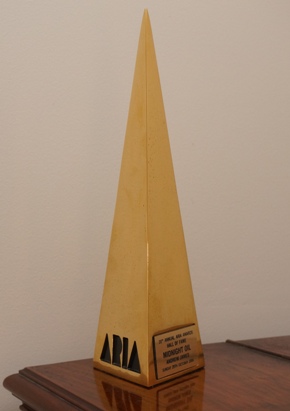
When I read in the papers that Midnight Oil were going to be inducted into the ARIA Hall of Fame in 2006 I made some enquiries with the event organiser. He directed me to the staff at Sony and they invited me to sit at their table for the event. It was great to see performances by Eskimo Joe, Silverchair and Bernard Fanning, but of course for me the highlight of the night was to see my band inducted into the Hall of Fame. Pete, Jim, Martin and Rob made a point of coming up to the Sony table from their front row table to say hello to me. I was hoping to meet Bones Hillman at the after party but didn't have access to get in to the room where the band were. Peter Gifford wasn't there that night, and in the back of my mind I wonder whether I would have been invited myself if I hadn't made enquiries.
I have also been interviewed and provided information for Andrew McMillan's book Strict Rules which documents the 1986 Blackfella Whitefella tour, and for Mark Dodson's 2005 book Beds are Burning.
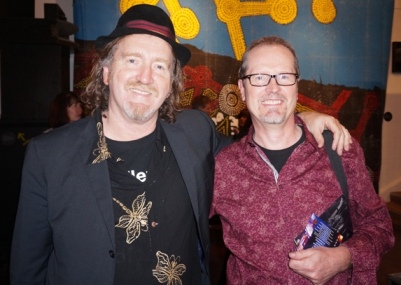
I met up with Jim, Rob, Peter and Gary at an exhibition of Midnight Oil memorabilia at the Manly Art Gallery & Museum in 2014. Many iconic items were on display, like the black tracksuits with the sorry insignia the band wore at the closing ceremony of the 2000 Sydney Olympics. Some items brought back memories, like a set list from the late '70's with song names I only vaguely recognised. Jim's four track tape recorder was also on display, but as it had previously fallen off a shelf in his studio it was no longer operational. Some items I had provided were also on display.
I also caught up with Jim, Peter and Martin at the launch of Peter Garrett's autobiography Big Blue Sky in late 2015.
Along with my son, daughter and son-in-law I saw a Midnight Oil warm-up gig at Selinas at Easter 2017, before they started their world tour.
At this gig they played The final note in this chapter is when my wife and I met Midnight Oil both before and after their final blistering concert
in Sydney at the domain on 17th November 2017. I got to meet "Bones" Hillman, their bass player, for the first and last time
and caught up with the rest of the guys,
hearing their war stories of passing viruses around whilst sharing the tour car in the US and Europe.
Jim was in a wheelchair after tearing his hamstring off the bone falling off stage the week before.
A few days after we spoke he was operated on so that he would be able to walk properly again.
Peter's parting words were that his next task was to "tackle the Tories".