The Nightlight Years
Flying with the Fox
As well as playing in Midnight Oil I still had connections with Christian musicians. After leaving Midnight Oil, and once my health had stabilised, I was free to see where these connections would take me. I had a day job now, so my involvement would not be full-time. I started to play mostly fretless bass in a number of light rock or jazz-folk ensembles which weren't really permanent bands.
I was spotted at a Christian gig by a musician who was putting together a band, which was initially named Signs of Life, but which soon became Flying Fox, with:
- Meryl Leppard - piano and vocals
- Dominic Reichel - guitar and vocals
- Geoff Crabtree - keyboards and vocals
- Mal Walker - drums
- Myself - bass and vocals
Our intial aim was to be cautiously evangelical without being bible bashers, bringing positive songs into a pub context, raising spiritual topics in our original songs and being open to witness to the audience after the show.
After a while, Meryl moved on to start a family and a solo career and was replaced by Naomi Warne. Although we did play some original numbers, as time went on I felt the band was becoming just another covers band, with very little to say.
Nightlight Nights
Whilst I was in Flying Fox, when I was available I was also playing in the Peter Beveridge band, which was an openly evangelical band playing all original material. I felt in my heart that this band was making a difference and although the songs Flying Fox were playing were musically satisfying, my energies would be better invested in the Peter Beveridge Band. After a considerable time of fence sitting I made the difficult decision to switch bands.
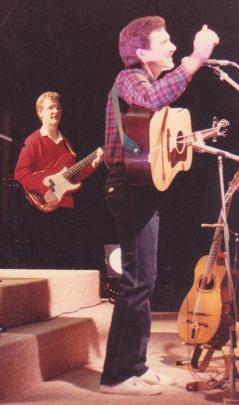
As well as having his own band, Peter worked in publishing. Over the next few years he set up his own publishing company, record company and recording studio. As well as playing live gigs in the Peter Beveridge Band, I was soon part of the Nightlight Music house band. We recorded mostly Christian albums for many people, and sometimes backed them live. I played fretted and fretless bass, and synthesiser bass. I also played on some early Hillsong studio and live worship albums, and at some Christian City Church (later C3) concerts. I played on albums by Nigel Compton, Dave Evans, Geoff Bullock, John Dickson, Glass Canoe (no 2 on the charts in South Africa) and many others, and often performed with the Nigel Compton band.
For a short while I also played fretless bass with a modern jazz trio with Mike Haughton and Alister Spence but was unwilling to tour overseas with them.
The core of the Nightlight Studios house band was:
- Peter Beveridge as producer and on keyboards and programming
- Phil Saddleton, initially on drum programming, and then when the studio was bigger, on acoustic drums
- David Holmes on guitars
- Myself on fretted and fretless basses
Other notable musicians who played with the Peter Beveridge Band, or who were involved in Nightlight Studio projects with me include Mike Haughton (woodwind), Phil Moore (keyboards), Dr Andrew (Andy) Gander (drums), Randall Waller (vocals, guitar and production), Andy Sorenson (keyboards and production), Wayne Gardner (not the motorcycle racer - guitar) and Nick Pansini (drums - now head of Pancini Percussion).
I can recall one disasterous gig playing with Peter and Phil Moore, where they were playing Prophet 5 synthesizers and I was playing my Juno 106 synth. The Prophets had analog oscillators and the unstable power supply in the venue was sending them crazy, so they kept drifting out of tune. My Juno had digital oscillators so it stayed in tune.
I can also recall one gig when Phil Moore and I were backing a vocal band called Dangerzone. The drums, guitar and some harmony vocals were on a Revox reel to reel tape player, and Phil and I played live keyboards. Towards the end of the set the tape player malfunctioned. Luckily we had enough songs that we could play without drums or other backing for the remainder of the performance.
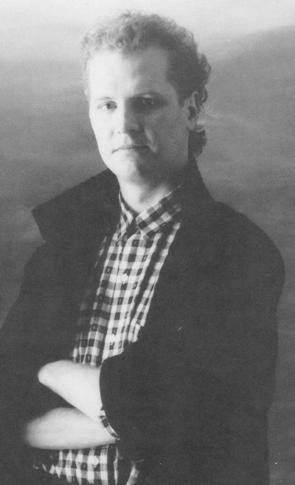
I co-wrote several songs with Peter Beveridge, and for a time we promoted ourselves as a duo called The Pulse, for which I sang and played keyboard bass, fretted and fretless basses, and electric guitar. We recorded one of our songs as a single, but the record company that released it went bankrupt.
Peter then formed a band called Present History with Darlene Zschech and the Nightlight Studios house band, and we released an album of great songs including one of mine. We played at a Hillsong event at the NSW State Sports Centre in front of about 7000 people (my largest audience).
Over time Peter moved away from live gigs and artist development, and into producing CDs for film and TV use, asking his network of composers for submissions. He also removed the vocals from the backing tracks that the Nightlight house band had recorded for his roster of artists over the years and edited these to be suitable for TV themes. One of the tracks I played bass on was used for a while as the theme for Australian Story on the ABC, and some of my and my wife's compositions and recordings were included on his soundtrack CDs.
As Peter's involvement in producing albums dwindled, I got fewer and fewer invitations to play in the studio and live.
I was a co-writer of the title track on Peter's second album, Static on the Frequency. (The album was renamed Grinding Wheel for its United States release). Static was used for a time by a radio station in the United States as the signature music for a late night radio program. In an unexpected development, Eminem (the rapper) heard the signature music on the radio station, liked it, and used the source music as backing for the track Detroit vs Everybody featuring an all star roster of rappers. This track was included on the album Shady XV and was released as the third single from his album in late 2014, reaching number 28 on the Billboard R&B/Hip-Hop charts. The two official videos have received over 30 million views on YouTube. Unfortunately music streaming generates almost no income for the composer, so very little actually found its way back to the original Australian contributors.